
SEO and GBP Trends for Australian Small Businesses
SEO and Google Business Profile Trends That Actually Matter for Australian Small Businesses in 2026
I am going to be blunt about something the SEO industry does not want to hear: most of the “SEO trends” content published in 2026 is recycled rubbish. The same vague predictions rehashed every January, written by people who have never actually ranked a website for a competitive keyword.
I have been doing SEO for Australian businesses for over 12 years. I have seen every Google update, every industry panic, every “SEO is dead” headline. And I can tell you that the changes happening right now are genuinely significant, but not for the reasons most articles are telling you.
This is not a list of 47 trends you should care about. This is a focused breakdown of the shifts that are actually affecting Australian small business visibility right now, what you should do about them, and what you can safely ignore.
The AI Overviews Reality Check
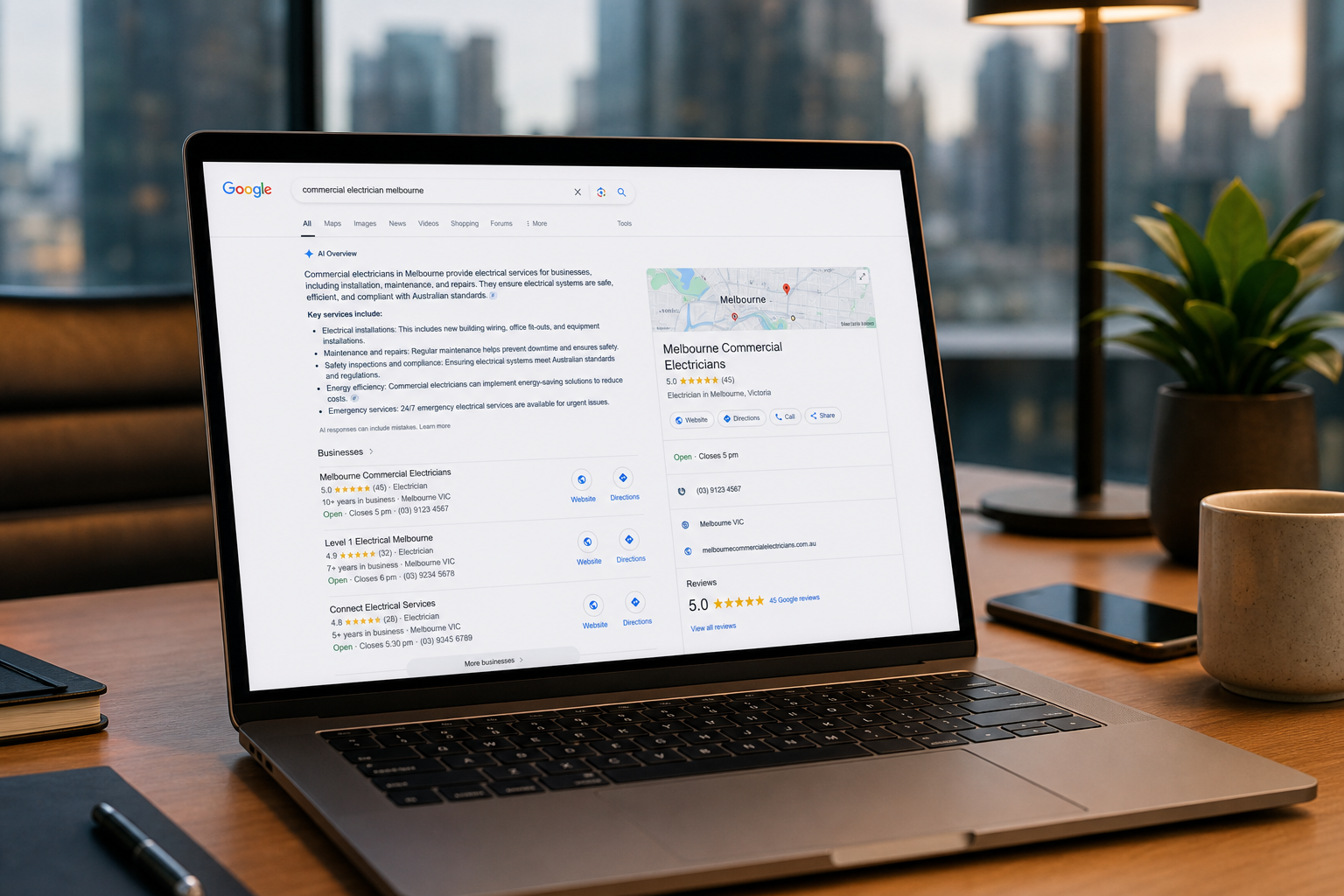
Let me start with the elephant in the room. Google’s AI Overviews, those AI-generated summary boxes that appear above traditional search results, are fundamentally changing how Australians find businesses online.
Here are the numbers that matter. AI Overviews now appear in roughly 13 to 20 percent of all Google searches, and that number is climbing. When they do appear, organic click-through rates drop by up to 61 percent on informational queries. Around 69 percent of Google searches now end without a click to any website at all.
That last number needs to sink in. Seven out of ten people who search on Google do not click through to a website. They get their answer directly on the search results page.
For Australian small businesses, this means the old playbook of “rank on page one and the traffic will come” is no longer sufficient. You can rank number one for your target keyword and still see declining traffic if Google is answering the query directly in an AI Overview.
But here is what most doom-and-gloom articles miss: the businesses that are being cited in AI Overviews are seeing massive benefits. Being the source that Google’s AI references is the new page-one ranking. And there is a roughly 62 percent overlap between pages that rank well in traditional search and those that get referenced in AI answers.
The takeaway is not “SEO is dead.” It is “SEO has evolved, and the businesses that adapt will win harder than ever.”
Generative Engine Optimisation: The New Layer
This is the term you need to know: Generative Engine Optimisation, or GEO. Some people are calling it AI SEO. Whatever you call it, the concept is straightforward. Structure your content so that AI systems can find, understand, and cite it.
GEO is not a replacement for traditional SEO. It is an additional layer. You still need solid on-page optimisation, quality backlinks, and technical SEO foundations. But you now also need to think about how AI systems process your content.

What this means in practice:
Write clear, direct-answer sentences early in your content. When someone asks “how much does a website cost in Melbourne,” your content should contain a clear, direct sentence that answers that question, not buried in paragraph seven, but prominent and unambiguous.
Use structured data and schema markup aggressively. AI systems rely on machine-readable structure to understand your content. If you are a Melbourne business and your website does not have LocalBusiness schema, FAQ schema, and service schema, you are invisible to AI systems that could be recommending you.
Organise content with clear headings and logical hierarchy. AI systems parse your content structure. Well-organised content with clear H2 and H3 headings, logical flow, and distinct sections is dramatically easier for AI to process and cite.
Include specific data, numbers, and examples. AI Overviews prefer content that contains concrete information: statistics, pricing ranges, step-by-step processes, specific recommendations. Vague, fluffy content gets ignored.
The businesses that optimise for both traditional search and AI citation will dominate their local markets. The ones that ignore GEO will wonder why their traffic keeps declining despite good rankings.
Google Business Profile: Still the Most Underutilised Asset
I say this to almost every client I work with: your Google Business Profile is probably the single most underutilised marketing asset you have. And the data backs it up.
Businesses with a complete Google Business Profile are 2.7 times more likely to be viewed as reputable. They are 50 percent more likely to be considered for potential purchases. And customers are 70 percent more likely to visit a business with an optimised profile.
The average local business Google Business Profile receives over 1,200 views per month. That is 1,200 potential customers seeing your business listing every month, and most businesses are treating their profile as an afterthought.
Here is what has changed in 2026 and what you should be doing:
Complete every single field. I cannot stress this enough. Every empty field on your Google Business Profile is a missed opportunity. Business hours, services, products, attributes, description — fill it all in. Google’s algorithm explicitly favours complete profiles.
Attributes matter more than ever. Google has expanded the attribute options: women-led, LGBTQ+ friendly, pet-friendly, wheelchair accessible, and dozens more depending on your category. These are not just nice-to-haves. Users can now filter search results by attributes, and AI systems use them to match businesses to specific queries.
Google Business Profile Posts are a free marketing channel that almost nobody uses properly. You can publish updates, offers, events, and articles directly to your profile. These posts appear in your listing and can influence both rankings and click-through rates. I recommend posting at least weekly — treat it like another social media platform.
Review velocity is the new ranking signal. It is not just about having a high star rating anymore. Google is looking at how consistently you are receiving new reviews. A business with 50 reviews that received 10 in the last month will typically outperform a business with 200 reviews that has not received a new one in six months. Ask for reviews systematically. After every project, every appointment, every positive interaction, have a system for requesting reviews.
Photos and videos drive engagement. Businesses with more than 100 photos on their profile get 520 percent more calls and 2,717 percent more direction requests than average. Upload quality photos of your work, your team, your premises, your products. Do it regularly.
Stop keyword-stuffing your business name. I need to address this directly because I still see businesses doing it. Adding keywords to your business name field (like “Best Plumber Melbourne – Joe’s Plumbing”) is a policy violation. Google is actively enforcing this, and the penalty is manual reverification or complete profile lockout. I have seen businesses lose weeks of visibility because of this. Use your actual, legal business name. Nothing else.
E-E-A-T Is Not a Buzzword, It Is the Content Filter
Experience, Expertise, Authoritativeness, and Trustworthiness. Google has been pushing this for years, but in 2026, E-E-A-T is the primary differentiator between content that ranks and content that does not.
Here is why this matters more now than ever. The internet is flooded with AI-generated content. Millions of articles are being published daily by businesses using ChatGPT to pump out generic blog posts. Google’s March 2024 Core Update specifically targeted and deindexed low-quality AI content, reducing it by an estimated 45 percent in search results.
The content that survives and thrives is content that demonstrates real experience, genuine expertise, and authentic authoritativeness. This is why my content philosophy exists: go deep, be opinionated, share real experience and real numbers. Generic surface-level content does not rank anymore because Google can spot it from a mile away.
What this means for your business:
Author bios matter. Every piece of content on your website should have a clear author with real credentials. Not “Admin” or “Staff Writer.” A real person with verifiable experience in the subject matter.
First-hand experience is gold. Google explicitly values content written from personal experience. If you have done something, built 200 websites, managed 50 SEO campaigns, implemented 30 CRM systems, say so. Reference specific outcomes, specific challenges, specific lessons learned.
Link to credible sources. Reference industry data, cite studies, link to authoritative Australian sources. This signals to Google that your content is well-researched and trustworthy.
Update your content. Stale content loses authority. Your “2024 SEO Guide” that has not been touched in 18 months is actively hurting your rankings. Update key pages regularly with current data and insights.
Local SEO: The Melbourne Advantage
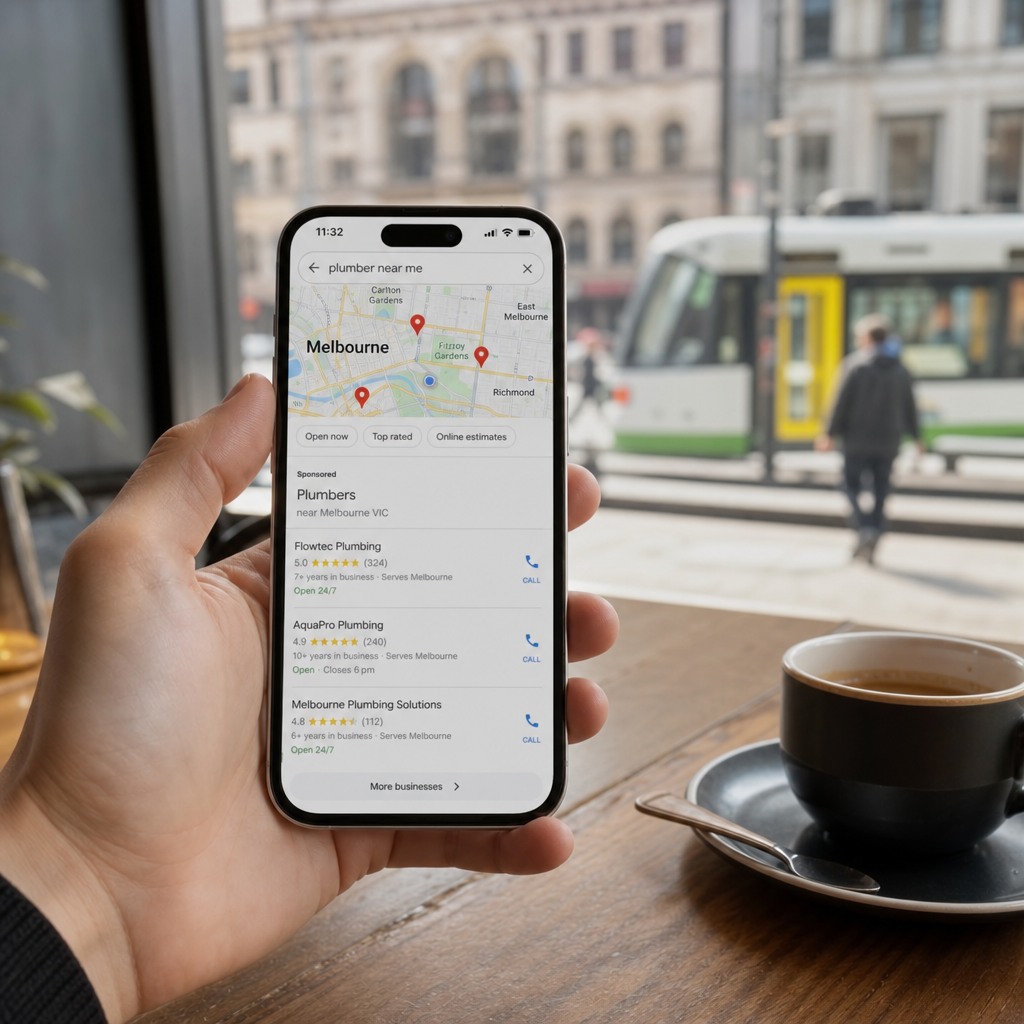
If your business serves Melbourne or anywhere in Australia, local SEO is not optional. It is your highest-ROI channel.
Local search drives 28 percent of total search traffic for Australian businesses and converts at three times the rate of general organic traffic. People searching “web designer Melbourne” or “SEO consultant near me” are not browsing. They are buying.
The local SEO fundamentals have not changed dramatically, but the bar has risen:
NAP consistency is still foundational. Your Name, Address, and Phone number must be identical across your website, Google Business Profile, and every directory listing. Inconsistencies confuse Google and hurt your local rankings. Audit your listings at least quarterly.
Local content is a ranking superpower. Create content that is specifically relevant to your location and audience. Not generic “SEO tips” content, but “SEO strategies for Melbourne professional services firms” or “website design considerations for Australian health practitioners.” Location-specific content signals relevance to Google and attracts exactly the traffic you want.
Local backlinks carry disproportionate weight. A link from a Melbourne business directory, a local industry association, or an Australian media outlet is worth significantly more for local rankings than a generic international link. Focus your link-building efforts locally.
Mobile optimisation is non-negotiable. Over 60 percent of local searches happen on mobile devices. If your website is not fast, responsive, and easy to navigate on a phone, you are losing the majority of your local search traffic.
Voice Search and Visual Search: Worth Watching, Not Panicking
Predictions about voice search dominating everything have been circulating since 2018. The reality is more nuanced. Voice search is growing, with roughly 50 percent of searches expected to be voice-activated by late 2026, but the impact varies by business type.
If you are a local service business, voice search matters. Questions like “who is the best web designer near me” or “find an SEO consultant in Melbourne” are increasingly spoken into phones and smart speakers. Optimising for natural language queries, the way people actually talk rather than type, is worth the effort.
The practical approach: add FAQ sections to your key service pages that use natural, conversational language. Answer the questions your customers actually ask, in the way they actually ask them.
Visual search through Google Lens is growing rapidly for product-based businesses. If you sell physical products, ensure your product images are high quality, properly tagged with descriptive alt text, and included in your image sitemap.
For most service-based Australian businesses, these are worth monitoring and gradually optimising for, not worth a complete strategy overhaul.
What You Can Safely Ignore
The SEO industry thrives on creating urgency around every new feature and algorithm tweak. Here is what I would not lose sleep over:
Chasing every algorithm update. Google makes thousands of changes per year. Most are minor. Focus on building a fundamentally strong website with great content, solid technical foundations, and genuine authority. The businesses that chase every update are the ones constantly on the back foot.
AI-generated content at scale. Pumping out hundreds of AI-written articles is not a strategy. It is a liability. Google is getting better at identifying and devaluing low-quality AI content. Quality over quantity is not just a platitude in 2026; it is a ranking strategy.
Buying backlinks. Still a violation of Google’s guidelines. Still risky. Still unnecessary if you are creating genuinely valuable content that earns links naturally. I have seen businesses penalised and lose months of traffic over purchased links. It is not worth it.
Social media signals as a ranking factor. Social media does not directly impact Google rankings. It is valuable for brand building, traffic, and engagement, but do not optimise your social strategy for SEO. Optimise it for your audience.
The Practical Roadmap
If I were sitting across from you right now, a Melbourne small business owner wanting to get this right, here is exactly what I would tell you to do:
Month one: Audit your Google Business Profile. Complete every field. Upload 20 quality photos. Set up a review request system. Start posting weekly.
Month one to two: Audit your website’s technical SEO. Fix page speed issues (aim for under 2.5 seconds load time). Ensure mobile responsiveness. Implement schema markup for your business type, services, and FAQ content.
Month two to three: Develop a content strategy based on the actual questions your customers ask. Not keyword-stuffed filler, but genuine, deep, authoritative content that demonstrates your expertise. Aim for one long-form blog post per week minimum.
Ongoing: Monitor your visibility in both traditional search and AI overviews. Track which queries trigger AI Overviews in your industry. Optimise your existing content for AI citation by adding clear, direct answers and structured data.
Ongoing: Build local authority through community involvement, local partnerships, and earning mentions and links from Australian sources.
This is not complicated. But it requires consistency, patience, and genuine expertise in your craft. The businesses that commit to this approach will dominate their local markets. The ones that chase shortcuts will continue wondering why their phone is not ringing.
And if you want the personalised version, the strategy tailored to your specific business, your specific market, your specific competitors, that is what the consultation is for. Everything I have shared here is actionable. Most businesses will read it, agree with it, and not do it. If you want someone to actually make it happen, that is where I come in.
Have a chat with an SEO Consultant such as myself either at my SEO Consultant website or contact me through this website here for a free no pressure consultation.
 What Is an AI Employee? How Australian Small Businesses Are Hiring Digital Workers in 2026